
OK, so money isn’t irrelevant …yet, but it will be. Like so many things that are in existence, they are only still used because they have either achieved global ubiquity, or there is nothing better to replace them, or both.

Money, in all its forms, is probably the definitive example of this, but I can actually see a time in the not too distant future when it will be replaced with what it has always represented; Value.

Let me take a step back here and say that this subject is wayyy too complex for me to do true justice, and I have no intention of reading any books on economics to ensure it’s factually accurate, but by its very nature, money is limiting to the continuation of globalisation. Like it or not, the world is getting smaller and less unique across traditional borders both physical and political. People are starting to want the same things, and while not all of things they want are good, the common ground between them is once again driven by value.

Money simply cannot keep up with the changes, and the massive complexity of producing cash, providing debit and credit services, exchange rates, inflation, and a plethora of other things I have made it my goal to never understand, will eventually drive a requirement for something new;

I’m calling it ‘Digital Identity and Virtual Value Management’.

Errr, what?

Another step back; In the past, if you were a wheat farmer and needed meat, you would exchange wheat for meat at a ratio you agreed directly with the person standing right in front of you. You would then each go on your way happy that you have received fair value for your goods. However, if you wanted dairy products, carpentry skills, metal working skills or a whole host of services, you had to repeat this process, and of course, the representative values would always change depending on your immediate needs.

Now, in a massively over-simplification of history and probably fact, it was decided in the year [mumble-mumble] that it would make sense to replace the bartering system with a universally agreed (i.e. by the ‘government’) meaningless object (money), which would represent the VALUE of every commodity so that the holder of this meaningless object was owed the value of it in any commodity they chose.

Great, so now instead of carrying around huge quantities of wheat, our farmer can now walk up to any provider of goods and exchange their meaningless objects for whatever they want.

Eventually these meaningless objects became paper-based, then plastic, and now it’s digital, but it’s still meaningless. Only the VALUE of what it represents means anything, and you SHOULD be able to spend that any time, any place, anywhere, without the need for a meaningless object.

Your identity should replace the meaningless object, and your value should replace money in all it’s forms.

But who sets your value? Who is to say that the services of a lawyer are more valuable than those of a plumber?

You do.

Currently, if you accept £50,000 / year for your employment, YOU are the one who set that value, not your employer. If you think you’re worth more, go somewhere else, or, what you should do is increase your value by improving yourself in some way (education, experience, work harder, you name it). And herein lies one of the biggest mistakes people make their whole lives; focussing on money when what they SHOULD be focusing on is improving their own worth, their VALUE to others.

So, what is Digital Identity? It’s the unequivocal ability for you to prove that you are you, to anyone, anywhere. If everyone in the world KNEW that you were you, then you would not need money, passports, or any physical form of identity. Whether this is effected by biometrics and knowledge verification or [more likely] a combination of these and other yet-to-be invented factors is unclear, but the digitalisation of everything will continue until this form of Identity Management is commonplace.

And Virtual Value? This you can see happening already with Bitcoin and its brethren. What’s missing is the input of non-monetary value, or in other words, I have no way of entering my self-determined worth into a virtual environment, then have others validate it for my actual work in a way that I can spend on something else. But this is coming too, it almost has to.

I can imagine a time when I perform a piece of work for someone, immediately be ‘credited’ with the agreed virtual value, then be able to walk into a store, pick up what I want and walk out again without performing any manual payment transaction whatsoever. My Digital Identity will be confirmed the second I walk into the store, the value of the goods will be automatically calculated based on my choices, and the value of those good will be deducted from my virtual net-worth (or Internet-worth! :)) as soon as I step back out into the street.

Seems rather ridiculous that we still use credit cards, doesn’t it?
For those who don’t know what the Rosetta Stone is, it’s a tablet found in 1799 that greatly assisted the translation of ancient Egyptian Hieroglyphs [subsequently] to every modern language.

So why do I use this as an analogy for non-cash payments?

Hieroglyphs​ had puzzled scholars for centuries until the Rosetta Stone unlocked them enough for the translation to move forward to completion. Having a software PIN will effect the exact same unlocking of the transition of non-cash payments from plastic to mobile. We have had payment cards for 60+ years, with nothing in that time anywhere near ubiquitous enough to disrupt them​, now ​we do. And while mobile devices are in no way perfect, and in many ways even less secure than payment card, ​they ​​are​ already far more prevalent​. ​Despite all ​of mobiles’s flaws, they ​are being used ​today as a payment medium​, a trend that will continue until plastic is replaced completely (at least in its current form).​

Th​ere are too many reasons​ for the continuity​ to go into​ here​ (sheer functionality being the top one), but it has been slow because until now every mobile payment innovation was just a little too much for people to accept, just a smidge too radical to gain the necessary momentum.

This is probably because none of those innovations kept the most widely used of the authentication mechanisms in the world; the PIN. The enormously complex and expensive chip & PIN (EMV) used for credit cards is accepted globally (if they can afford it), but up till now there has been no way to effect an acceptable level of security on a device that is never going to be as secure as a system built for purpose.

But ‘as secure’ is not the point, ‘secure enough’ is. You’re not fighting for perfection and zero loss through theft, you’re fighting for making it too difficult for thieves to bother. This can only be effected by layers of security, the so-called defence-in-depth. EMV put all of its security controls into a single factor (they had no choice), but mobile devices have access to numerous – and ever expanding – options:

  1. Geolocation/Geofencing: Whatever you want to call it, and whatever buzz phrases vendors will come up with next, they all mean the same thing; are you where you should be? Should you be paying for something in Glasgow if you live in London? Maybe, but when you set the areas from which payments can be made, you are removing the majority of the bad guys’ ability to process a fraudulent transaction.
    Yes, there can be privacy issues, but most vendors have dealt with that now.
    o
  2. Device Authentication: Every mobile phone has a serial number, IMEI number, and other built in identifiers. If your device is registered it’s very difficult to use another device to get in the middle. Not impossible, just difficult.
    o
  3. Application Signing and Authentication: Minimal security in and of itself, but is another security layer which ensures as much as possible that only known good apps are used. Apple and Google have their own ways of doing this for downloads, neither of which is adequate. Ongoing application verification can be relatively useful though.
    o
  4. App Blacklisting / Malware Detection: Very early days yet for mobile devices, but in the same way that operating systems anti-virus vendors have made untold fortunes regurgitating known bad things into signatures, mobile devices will have the ability to blacklist apps that should never be running on devices secure enough to authenticate payments. OS hardening guides (SELinux for example) and version control (Android must be at v4.2 and above for example) are fundamental baselines.
    o
  5. PIN Image ‘Watermarking’: Most internet banking sites now have a facility whereby you can upload a personal image to ensure that your open communication is actually with your bank and not redirected to a bad guy. Mobile devices make this factor possible and can even be configured into the PIN pad image.
    o
  6. Encryption (Packet and Transport Layer): Obvious stuff, and relatively trivial to circumvent when you have access to the base operating system kernel (where all jailbreaks take place), but still a very valid concept, especially when you consider the very clever technology surrounding things like Secure Remote Password protocol (SRP).

​Even today there are more options than this, and even implementing all of them at once is seamless to the end user once they have registered their device​. Any one of these by itself is clearly inadequate, but can you really see a bad guy sitting in Starbucks cracking ALL of these in the few moment it takes you to pay for your coffee?

By their nature, mobile devices will always be insecure and limited (bloated OSs, battery life, delicacy, theft and so on) and cannot be seen as a long term solution in payments the way the credit cards were, but I don’t think anyone can deny that they will replace plastic. Mobile devices will take payments to places credit cards can never reach, and the functionality and distribution of payment innovation through mobile devices will grow exponentially over the next 5 – 10 years, it just needs something to help everyone make that transition;

The software PIN.

[If you liked this article, please share! Want more like it, subscribe!]

For generations – quite literally – credit cards have ruled the non-cash payments world, but it’s now time to start saying goodbye to the ‘plastic’.

At the time of their introduction (way back in the late 1950’s early 60’s) they were a fantastic innovation, and they have rightly had their decades in the sun. Until now, there has been nothing to replace them, nothing anywhere near as widespread, ubiquitous, incredibly versatile, and still growing as a market.

Now there is.

I am talking of course about the mobile phone, but as I will try to demonstrate here, I’m convinced that this is just a reactive and brief stepping stone, and it will not be 60 more years before that next transition comes about.  Actually, it’s already happening.

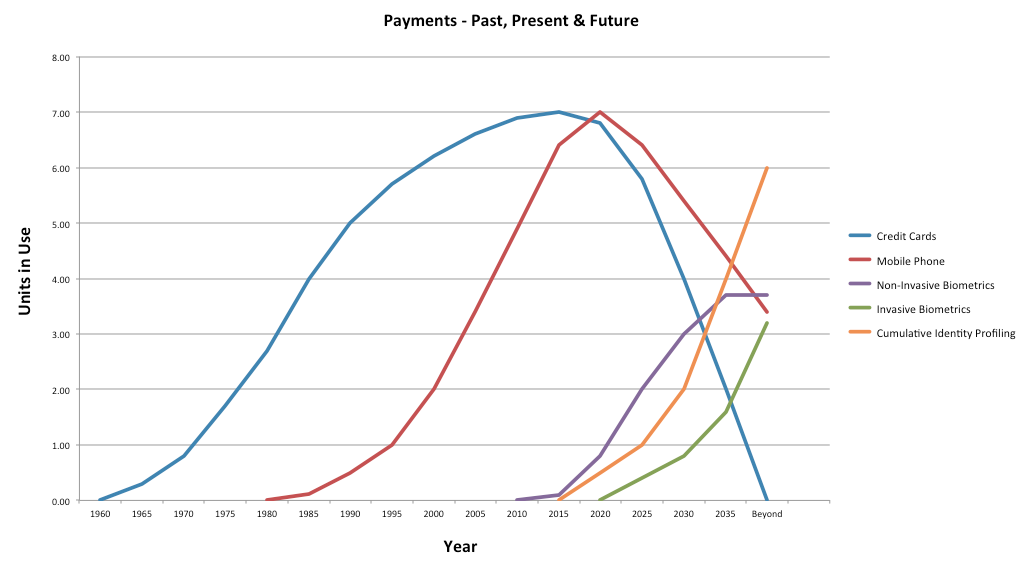
The table below represents my thoughts on the next steps, and are not based on anything resembling research, known statistics, and maybe even reality. This is just a visual representation of what I believe;

Screen Shot 2014-03-20 at 10.27.12

Credit Cards – Began way back when, and have enjoyed an enormous growth over the years. However, the up-front nature of the card itself has required a massively expensive infrastructure to accommodate it, leaving half the planet un-covered and un-banked. Beginning this decade we will see a rapid decline in their use as consumer choices expand, and issuer’s profits drop.

Mobile Phone – Enormous and unprecedented growth and owned by more people than any electronic product in history. Anyone who believes that the inherent insecurity and inconvenience of battery life will prevent the transition of payments onto this platform is going to be left behind. Nevertheless, these limitations WILL ensure that the transition to what’s next in payments comes much faster than the move from plastic. Rapid advances in battery technology and OS security will maintain the trend for a few years.

Non-Invasive Biometrics – As I’m calling it, but I basically mean wearables and anything else that comes up that starts doing away with the keyboard and begins the process of identity management through non-static authentication (passwords, secret information), and learning the wearer’s physical profile to effect the majority the functionality. Voice at first I assume.

Invasive Biometrics – Implants in other words. There will be those who say this is a ridiculous concept, that it will never take off, but I believe that the next generations will not see this as outrageous, and WILL see the mobile phone as antiquated and inconvenient. Anyone who has seen the 2012 version of Total Recall and the phone implanted into Colin Farrell’s hand either said “NO WAY!”, or like me said “I WANT ONE!”. Batteries will always be a limitation, but the human body IS a battery (of sorts), and it will be harnessed accordingly (hopefully not like in The Matrix).

Cumulative Identity Profiling – Again, this is what I’m calling it, but it’s basically the culmination of the trend toward a totally different idea of privacy, and one that I cannot see clearly because I’m not of this yet-to-be-born generation. Anyone who is the parent of a teenager knows that their kids have never NOT had a mobile  phone, and that almost their entire life is recorded online. The are never unplugged. We are horrified for them, but that’s our judgement, not theirs, and theirs will win. Identity Management and authentication will be a sum total of your life’s experiences, and therefore almost impossible to fake, or duplicate. The whole concept of privacy will be turned on its head.

There are those who say that this can only happen in industrialised nations, those with the money to afford such things, and yes, there will always be a portion of the population who will be out of the loop for a while. However, Mozilla (for example) are releasing a $25 smartphone, and it is estimated that within a few years Africa with have a 50% smartphone adoption. This trend will cover almost everyone, eventually.

The innovation involved with payments is really at the beginning of its evolution, and I’ll probably look back on this post in 5 years time and laugh at my naivety. Nevertheless, the card brands know its coming (hence NFC, HCE etc.), the terminal manufacturers know its coming (hence the rise of phone based mPOS), and the retailers know its coming (hence the push back on EMV), so the only thing left is for the consumer to start making demands and there will be no looking back.

The average consumer will forgo security for convenience, it will be up to the payments innovators to make sure enough security is built in to protect people from themselves. Which I think is unfortunate, but it’s that or educate 7 billion people.

In the near future, most of us will want to:

  1. be able to walk into the supermarket, collect our stuff, and walk straight out with the payment already processed in the background
  2. receive instant coupons, or 2-for-1 offers, or other value add services WHILE shopping
  3. receive a warning if an item contains something to which we are allergic
  4. receive a reminder from your fridge / freezer / cabinets that you are low on certain products while you are walking down the relevant aisle
  5. …and so on.

However, you cannot have any of these things unless you made the necessary information available to the supermarket chain you are in. And they will not make these things available TO you unless they have good assurance that you, are in fact, you.

To enable just those 4 things listed above, you had to release a significant amount of personal data, all of which can have privacy implications:

  1. requires a number of things – from biometrics (facial recognition for example) to financial account access
  2. requires a comprehensive and always growing record of your choices, preferences, and habits
  3. requires details of certain bits of medical data
  4. requires your entire kitchen / bathroom / bedroom to be enabled for the Internet of Things, as well as a highly detailed geolocation on your whereabouts
  5. …and so on.

Are you OK with that?

I am, but I know many who are not, and I also know that as the generations progress, there will be less and less concern over these ‘conveniences’, as they will have become common place. I will go as far as to say that within the next 10 years, any supermarket NOT providing some of all of these services will not be able to compete, and possibly become Internet-Free corner stores where you’ll find the world’s ‘privacy paranoid’ shopping for their tin-foil helmets and electronic cloaking devices.

The bottom line is that the concept of privacy itself is changing. The generation of kids in secondary schools today has never known life without the Internet, and in most industrialised nations, every kid has a mobile phone. They are always plugged in, always connected, and, as never before, a vast majority of their lives is recorded somewhere online. They are active on social media, SMS, chat, email, and every other technology designed to stay in touch 24/7.

Our idea of privacy is not theirs, and everything from racial prejudice to the stigma attached to nudity will standardise and globalise, and I cannot help but think for the better. Your children’s education will no longer be tied entirely to the doctrines of the previous generations, and self perpetuating ignorance has no place in a time when every piece of knowledge is at your fingertips. Not that this will stop those determined to be an arse.

I’m certainly not talking about some utopia here, ignorance in all its forms will never go away, but if the vast majority of your life is an open and available book, your complete identity becomes an ultimate form of authentication, and the security OF your identity only gets better as your life progresses.

The current ability to authenticate only against static data will no longer suffice (passwords, secret questions etc.), and the coming methods of identity management and authentication will completely change the face of privacy.

I see this as a good thing, but I’ll leave it to the folks hiding away in Faraday cages to make sure that Big Brother doesn’t get everything his way.


In continuation of my crusade against EMV in general, the card schemes have announced an end to issuer-only fraud liability for non-chip transaction starting in October 2015. The so called ‘liability shift’.

For those who don’t know, it’s the issuers of the credit card that accept the liability for fraud during a branded credit card transaction, which is why they receive the lion’s share of the fees associated with the transaction (interchange fees). But now, if the merchant does not upgrade their point-of-sale terminals to those capable of accepting chip cards, it’s the merchant who suffers the fraud loss. Same thing goes for a consumer who wants to continue using swipe  & signature cards.

While I assume that those with disabilities, and / or the elderly will be given the option to not change to chip & PIN, the fact remains that the enormous cost of the transition to this ‘new’ technology will not be born by those who have basically created the problem over the course of over 60 years; the card brands. It will be the consumer …eventually, because the merchants / retailers will have to re-coup their up front costs.

And all this just to keep taking credit cards!

Why do retailers and banks STILL see credit cards as the only form of non-cash payment? Why DO the card brands have so much power over end-user payments technology when there are ‘only’ ~6 billion credit cards in the world and >7 billion mobile phones? On top of that, mobile phones have a far wider distribution than an EMV infrastructure can EVER hope to duplicate, and you have what I would see as a very simple choice in how to transition away from plastic.

I’ve said it repeatedly; payments is NOT about the FORM of payment, it’s about authentication of the individual to the organisation holding the funds (usually a bank), and NO form of account-detail-up-front (read credit card number, even a token of one) can ever be as secure as one protected by proper identity management. Yes, even on a mobile device.

What the US retailers are going to do is spend an absolute fortune on a payment acceptance technology that will be impossible to upgrade to anything else, nor will it be anywhere near as flexible for those retailers wishing to innovate in new forms of value-add services and marketing drives.

I have no problem with the card brands making a ton of money, that’s business and they do have a lot to add in the payment arena, but to continue the push for EMV is as horrendously self-serving as it is pointless. If it’s not them pushing for it, and it’s actually the Fed, then THEY should do their homework and talk to the retailers.

However, if the retailers aren’t going to do anything about this, then it pretty much serves them right.

For example; What card brand or issuer is going to tell Walmart that they can’t use an EMV alternative that has been shown to have a similar security profile AND infinitely greater business benefits? Can you really see them giving up a multi-million dollar revenue stream just to enforce a patch on a 60+ year old technology?

No, neither can I.