
For generations – quite literally – credit cards have ruled the non-cash payments world, but it’s now time to start saying goodbye to the ‘plastic’.
At the time of their introduction (way back in the late 1950’s early 60’s) they were a fantastic innovation, and they have rightly had their decades in the sun. Until now, there has been nothing to replace them, nothing anywhere near as widespread, ubiquitous, incredibly versatile, and still growing as a market.
Now there is.
I am talking of course about the mobile phone, but as I will try to demonstrate here, I’m convinced that this is just a reactive and brief stepping stone, and it will not be 60 more years before that next transition comes about. Actually, it’s already happening.
The table below represents my thoughts on the next steps, and are not based on anything resembling research, known statistics, and maybe even reality. This is just a visual representation of what I believe;
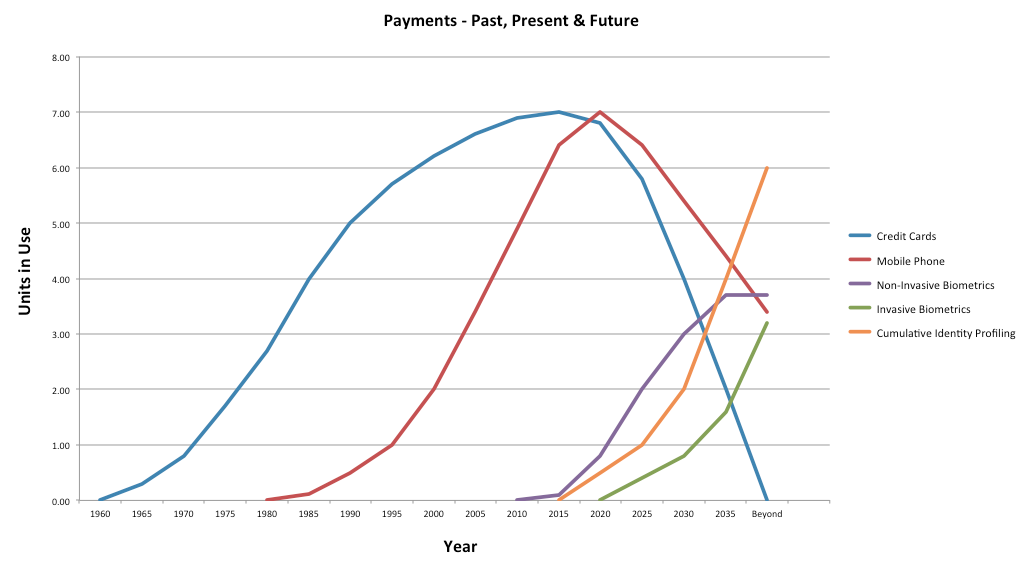
Credit Cards – Began way back when, and have enjoyed an enormous growth over the years. However, the up-front nature of the card itself has required a massively expensive infrastructure to accommodate it, leaving half the planet un-covered and un-banked. Beginning this decade we will see a rapid decline in their use as consumer choices expand, and issuer’s profits drop.
Mobile Phone – Enormous and unprecedented growth and owned by more people than any electronic product in history. Anyone who believes that the inherent insecurity and inconvenience of battery life will prevent the transition of payments onto this platform is going to be left behind. Nevertheless, these limitations WILL ensure that the transition to what’s next in payments comes much faster than the move from plastic. Rapid advances in battery technology and OS security will maintain the trend for a few years.
Non-Invasive Biometrics – As I’m calling it, but I basically mean wearables and anything else that comes up that starts doing away with the keyboard and begins the process of identity management through non-static authentication (passwords, secret information), and learning the wearer’s physical profile to effect the majority the functionality. Voice at first I assume.
Invasive Biometrics – Implants in other words. There will be those who say this is a ridiculous concept, that it will never take off, but I believe that the next generations will not see this as outrageous, and WILL see the mobile phone as antiquated and inconvenient. Anyone who has seen the 2012 version of Total Recall and the phone implanted into Colin Farrell’s hand either said “NO WAY!”, or like me said “I WANT ONE!”. Batteries will always be a limitation, but the human body IS a battery (of sorts), and it will be harnessed accordingly (hopefully not like in The Matrix).
Cumulative Identity Profiling – Again, this is what I’m calling it, but it’s basically the culmination of the trend toward a totally different idea of privacy, and one that I cannot see clearly because I’m not of this yet-to-be-born generation. Anyone who is the parent of a teenager knows that their kids have never NOT had a mobile phone, and that almost their entire life is recorded online. The are never unplugged. We are horrified for them, but that’s our judgement, not theirs, and theirs will win. Identity Management and authentication will be a sum total of your life’s experiences, and therefore almost impossible to fake, or duplicate. The whole concept of privacy will be turned on its head.
There are those who say that this can only happen in industrialised nations, those with the money to afford such things, and yes, there will always be a portion of the population who will be out of the loop for a while. However, Mozilla (for example) are releasing a $25 smartphone, and it is estimated that within a few years Africa with have a 50% smartphone adoption. This trend will cover almost everyone, eventually.
The innovation involved with payments is really at the beginning of its evolution, and I’ll probably look back on this post in 5 years time and laugh at my naivety. Nevertheless, the card brands know its coming (hence NFC, HCE etc.), the terminal manufacturers know its coming (hence the rise of phone based mPOS), and the retailers know its coming (hence the push back on EMV), so the only thing left is for the consumer to start making demands and there will be no looking back.
The average consumer will forgo security for convenience, it will be up to the payments innovators to make sure enough security is built in to protect people from themselves. Which I think is unfortunate, but it’s that or educate 7 billion people.