
It was inevitable I suppose, that once the dust had settled somewhat the lawsuits would commence. It’s America after all. It’s not bad enough that Target have already spent millions on this event, and will spend millions more patching the problems and covering the losses, now the banks want a piece. The BANKS!

These same banks have MADE millions off credit card transactions over the years, and now that the downside of their venture has reared its ugly head they go crying to the courts to whine about how unfair this all is. I dare say that eventually some of these plaintiffs will be the very Issuers that have managed to block EMV for so long.

Not that EMV would have prevented the breach mind you, it would have made no difference, but the monetisation of the breach would have been far more difficult. My thoughts on why EMV was never rolled out in the US – and never SHOULD in my opinion – is here; Why the US Will Not Adopt EMV (Chip & PIN).

Then there will be the QSA and MSS companies, and the integrity-less leaches who will jump all over this to try to steal the Trustwave client base. They will point to the breach and say that the Trustwave QSAs didn’t do their job, missed something, or worse, that they lied. The fact is that not one QSA or MSS in the WORLD following the PCI DSS as written could possibly find every hole in ANY client’s infrastructure, let alone one the size of Target.

I’m not saying that they did their jobs perfectly, I don’t know if they did or not, but I CAN say that they were not watching EVERY system and EVERY individual, EVERY minute, of EVERY day, which is what it would have taken to prevent the breach. The QSA looked at a justified SAMPLE of systems ONCE in the course of a year, that’s what a PCI assessment is, and the MSS would only be monitoring a fraction of the network traffic.

And then of course there are the journalists covering this story. It’s news, no doubt about that, but HOW it’s told will have repercussions. There are actually very few people in the world who can have a truly valid opinion on this matter, and fewer still who are the people actually writing the stories, which means that most of what you will see is based on either the facts only (yeah, right), or what sells. Decisions get made on sensational stories every day, sadly this will also be the case here.

This entire case is not some lessons-learned exercise, nor should it be used to crucify the named participants, this is an indictment against credit cards and the credit card companies themselves who have done too little for too long to innovate away from the current technology. Card numbers are a liability, EMV is a joke, and PCI is smoke and mirrors.

It’s time for them ALL to go away and allow the true nature of payments to shine. Identity Management will rule the day, not plastic.

I am probably someone with the most reason to jump on the bash-Trustwave bandwagon, but if I don’t – who for many reasons IS one of the people that can have a valid opinion – then maybe you shouldn’t either.

Of course, if Trustwave WERE found to be negligent, then I take most of this back, just not the part about credit cards going away.
Assuming you’ve performed the Risk Assessment correctly, you will already have the majority of the PCI assessment pre-requisites in place, or at least mostly in place. Now it’s time to get them optimised, and formalised.

The 5 pre-requisites are:

Management Buy-In – If you have not already got this, go back and get it, or if you ARE the management, start taking this more seriously. There is nothing more futile than trying to achieve compliance when it’s clear that management couldn’t care less. Even the appearance of caring is enough to galvanise all levels of an organisation to get the job done, thereby saving enormous amounts of resource and capital costs. The Risk Assessment should have all the ammunition you need to show senior leadership the benefits of an optimised security posture as it puts the loss of data asset Confidentiality, Integrity, and Availability (CIA) into terms they can understand; money.

See Top 10 Roadblocks to PCI Compliance and  How Information Security & Governance Enable Innovation for a little context on management buy-in and CIA respectively.

Asset Inventory / Register / Database – Does not matter what you call it, it’s a list of all of your assets with enough data points to make the list relevant. For some reason the DSS did not make this a requirement until v3.0, but I cannot even begin to fathom how anyone ever achieved compliance without one. EVERYTHING you do in security has asset management at its core, and there is no appropriate security without asset management done well. The register will include all physical devices and applications (CoTS, custom and DB) but should also include overarching business processes and even people’s special knowledge or necessary skill-sets.

At a minimum, the asset register should record the following; Unique ID #, Friendly Name, Hostname, IP Address, Function, Make, Model, Location, Owner. Of course, you should go MUCH further than this and add things like compliance relevance(s), system dependencies, running service baselines and so on.

Network Diagram – There are a thousand ways to do this, but really only one way to do it well. You start with your asset register, some network scans, and Visio (or equivalent). As long as all of your assets are represented (does not have to be individually), and every sub-net / VLAN reflected, the rest is just in the detail.  Complex is not sustainable, so if your diagrams are monstrous or very difficult to subdivide, then there is a good chance your infrastructure should be reviewed. However:

  • Layer 1 – IP, VLAN, ethernet port addresses and so on. Network admins use this for troubleshooting and it must be sustained at this level. QSA will use this for rule set reviews.
  • Layer 2 – All detail is taken away leaving only the ‘Friendly Names’ from the asset register.
  • Layer 3 – Business process flows (as many as it takes)

Data Flow Diagram + Detailed Narrative – You cannot have effective change control or business transformation processes unless you can determine change impact on all system dependencies. These flows are an asset in and of themselves and should be treated accordingly (i.e. with ownership, and regular reviews for accuracy).  Something as simple as numbered arrows from systems-to-system will suffice. For PCI, these data flow diagrams must be identical in format to the network diagram, hens the layering in Visio.

The data flow narratives are a ‘painfully detailed’ explanation of what happens to the data at every touchpoint. For PCI this will include storage (location / time), storage of what (data elements), truncation, encryption (type and strength) and so on. This is not a summary, this is everything.

Key Stakeholder Matrix – I have performed  2 month consulting gigs at large organisations where the first 6 weeks was spent finding the right people to talk to. Job knowledge and responsibilities are just as much an asset as the systems they maintain. Incident response and disaster recovery are not possible without application of the right knowledge, to the right place, at the right time, so knowing who knows what SHOULD be mandatory.

Eventually I will provide some samples, but for now, these descriptions should make sense. If not, ask your QSA / consultant, and if THEY don’t know, you should replace them.

These 5 things are not PCI requirements, these are SECURITY requirements. Done properly, everything you need for PCI falls out the back-end.

For generations – quite literally – credit cards have ruled the non-cash payments world, but it’s now time to start saying goodbye to the ‘plastic’.

At the time of their introduction (way back in the late 1950’s early 60’s) they were a fantastic innovation, and they have rightly had their decades in the sun. Until now, there has been nothing to replace them, nothing anywhere near as widespread, ubiquitous, incredibly versatile, and still growing as a market.

Now there is.

I am talking of course about the mobile phone, but as I will try to demonstrate here, I’m convinced that this is just a reactive and brief stepping stone, and it will not be 60 more years before that next transition comes about.  Actually, it’s already happening.

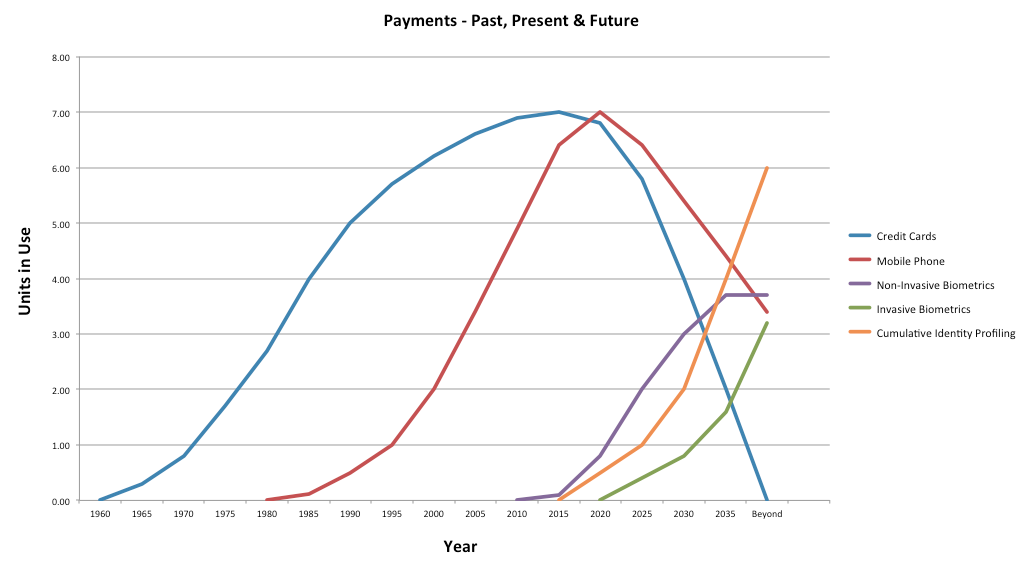
The table below represents my thoughts on the next steps, and are not based on anything resembling research, known statistics, and maybe even reality. This is just a visual representation of what I believe;

Screen Shot 2014-03-20 at 10.27.12

Credit Cards – Began way back when, and have enjoyed an enormous growth over the years. However, the up-front nature of the card itself has required a massively expensive infrastructure to accommodate it, leaving half the planet un-covered and un-banked. Beginning this decade we will see a rapid decline in their use as consumer choices expand, and issuer’s profits drop.

Mobile Phone – Enormous and unprecedented growth and owned by more people than any electronic product in history. Anyone who believes that the inherent insecurity and inconvenience of battery life will prevent the transition of payments onto this platform is going to be left behind. Nevertheless, these limitations WILL ensure that the transition to what’s next in payments comes much faster than the move from plastic. Rapid advances in battery technology and OS security will maintain the trend for a few years.

Non-Invasive Biometrics – As I’m calling it, but I basically mean wearables and anything else that comes up that starts doing away with the keyboard and begins the process of identity management through non-static authentication (passwords, secret information), and learning the wearer’s physical profile to effect the majority the functionality. Voice at first I assume.

Invasive Biometrics – Implants in other words. There will be those who say this is a ridiculous concept, that it will never take off, but I believe that the next generations will not see this as outrageous, and WILL see the mobile phone as antiquated and inconvenient. Anyone who has seen the 2012 version of Total Recall and the phone implanted into Colin Farrell’s hand either said “NO WAY!”, or like me said “I WANT ONE!”. Batteries will always be a limitation, but the human body IS a battery (of sorts), and it will be harnessed accordingly (hopefully not like in The Matrix).

Cumulative Identity Profiling – Again, this is what I’m calling it, but it’s basically the culmination of the trend toward a totally different idea of privacy, and one that I cannot see clearly because I’m not of this yet-to-be-born generation. Anyone who is the parent of a teenager knows that their kids have never NOT had a mobile  phone, and that almost their entire life is recorded online. The are never unplugged. We are horrified for them, but that’s our judgement, not theirs, and theirs will win. Identity Management and authentication will be a sum total of your life’s experiences, and therefore almost impossible to fake, or duplicate. The whole concept of privacy will be turned on its head.

There are those who say that this can only happen in industrialised nations, those with the money to afford such things, and yes, there will always be a portion of the population who will be out of the loop for a while. However, Mozilla (for example) are releasing a $25 smartphone, and it is estimated that within a few years Africa with have a 50% smartphone adoption. This trend will cover almost everyone, eventually.

The innovation involved with payments is really at the beginning of its evolution, and I’ll probably look back on this post in 5 years time and laugh at my naivety. Nevertheless, the card brands know its coming (hence NFC, HCE etc.), the terminal manufacturers know its coming (hence the rise of phone based mPOS), and the retailers know its coming (hence the push back on EMV), so the only thing left is for the consumer to start making demands and there will be no looking back.

The average consumer will forgo security for convenience, it will be up to the payments innovators to make sure enough security is built in to protect people from themselves. Which I think is unfortunate, but it’s that or educate 7 billion people.

In this, my first installment of the PCI DSS ‘Going Beyond the Standard Series‘, I will begin where not only every PCI assessment should start, but where the development of every security program should start; the Risk Assessment.

Just because you take branded cards, or in any way transmit process or store cardholder data, does NOT mean you should drop what you are doing and dedicate an enormous chunk of your IT capital or manpower resources into achieving compliance. Unless a) there is a distinct business benefit for doing so, and/or b) you are actually increasing the security posture of your entire business.

PCI is not about compliance, it’s about not losing cardholder data.

Compliance with the PCI DSS does not equal security, and security out of context has no business benefit. Either start your PCI program with an eye to staying in business responsibly or don’t bother.

Also, there is a very good chance that taking card payments is not core to your business. If you’re a retailer, your core business function is to sell things, taking payment is just a means to that end. Payment acceptance channels in your business should therefore be simple, inexpensive, and secure. If you can do this well yourself, great, if not, why take the risk? And can you truly innovate away from credit cards if you have to do all the work yourselves?

Should you decide that your existing payment channels are fit for purpose, the second question to ask that is how much should you be spending to fix / mitigate / transfer / remove any problems. i.e. a Business Impact Analysis. You would not spend £100,000 to protect £1,000 worth of data, but you likely would the other way around. Do you know what that balance is for your organisation? From my experience, the answer is generally no, and countless hours and capital are/is lost chasing a goal that was never properly defined.

That said, in terms of PCI, if you were doing security properly, you would already BE PCI compliant (mostly anyway), so it makes sense to just focus on security first and achieve compliance in your own time. As long as you have a reasonable project plan to show your acquirer, report your progress on time, and actually work towards your plan, you will pretty much get as much time as you need to get there. It’s the organisations that couldn’t care less, or are egregiously lax in protecting cardholder data that get the negative attention, and possibly the fines.

Sadly, along with Policies, Standards & Procedures, the Risk Assessment is often one of the last requirements to close during a PCI assessment, when, if they were in place at the beginning, the cost AND level of effort to sustain compliance would have been cut in half.

However, the issue is that most organisations do not have internal resources qualified to perform, or dedicated to, this task. It’s far too specialised, and has never been seen as a true value-add to the business. And unfortunately, the resources available to you in the QSA consulting arena are on the whole inadequate to the task of doing anything other than a PCI ‘audit’. So unless you know security, you would probably not even know the right questions to ask.

I probably should have made choosing the right QSA / consultant for your business the first of this series, but I have basically covered that in previous articles / white papers;

  1. How to Sell Security: While designed primarily to help salespeople in the information security arena, it doubles as a paper for anyone looking to BUY security services;
  2. Selecting The Right QSA For Your Business: This could just as easily be called ‘Questions For Your QSA Request For Proposal (RFP)’ as getting the help of a real security consultant and not ‘just a QSA‘ is critical;
  3. It Takes a Consultant to Hire a Consultant: One of the most difficult aspects of choosing the right help for your organisation, which begins with asking the right questions.

Bottom line; If you haven’t performed a Risk Assessment, go back and do it, and if you cannot do this yourself, find someone who can.

If you don’t know the right questions to ask, ask someone who does.

[If you liked this article, please share! Want more like it, subscribe!]

In a previous blog How to Achieve Compliance on the Road to Real Security I stated my intention to write a series of articles on; “…the intent of the 12 main sections of the PCI DSS, as well as provide guidance and options on how to go above and beyond PCI…”  Well, here it is …finally.

For this series, I will provide 3 distinct elements for each aspect of the PCI assessment process, the LAST 12 of which will be the PCI DSS v3.0 requirements sections themselves. I do this because you should not even be LOOKING at these until you have completed several pre-requisites.

The first is performing a Risk Assessment, the second is choosing the right QSA / consultant to help you.

Element 1 – Intent: One of the most confusing things about the DSS – to both layman and crappy QSAs alike – is how can a controls standard that is the most prescriptive of any regulation to date, be open to so much interpretation? How can QSAs have different opinions, or worse, how can QSAs working for same QSA company have different opinions?

Well, you just have to look at how many times the word ‘periodic‘ appears in the DSS to begin to figure this one out; 11 times against 5 distinct requirement sections (3, 5, 8, 9 & 10). Or how about ‘appropriate‘?; 15 times, also in 5 distinct requirement sections (2, 4, 6, 9 & 12). Or ‘applicable‘?; 15 times in 6 distinct requirement sections (2, 3, 5, 6, 8, 11 & 12).

But the prize for ambiguity goes to 2.2.1.a.; “Select a sample of system components and inspect the system configurations to verify that only one primary function is implemented per server.”  The SCC does – in v3.0 anyway – provide guidance that this means you should not have functions at different ‘security levels’ on the same server, but ‘security levels’ as defined by whom?

For a number of years the SSC has been trying desperately to bring the standard into line with a more risk based approach. For example, in the requirements section, the word ‘risk’ appears 20 times in v3.0, compared to v1.2 in which it appeared only 5 times; Patching requirements have gone from ‘you will do it in 30 days’, to ‘do it in 30 days IF it’s appropriate’; and so on…

It all boils down to the INTENT of each section, and too often, the standard is seen as a black and white / all-or-nothing checklist with no room to actually fit the security goals into the business as a whole. This is not the case, so an understanding of the intent is critical before making ANY move to become compliant.

Element 2 – Above & BeyondThe second thing I will attempt to do is explain that every requirement is a bare minimum, so going just a little bit above and beyond is not only the RIGHT thing to do, it builds a portfolio of compensating controls that, if applied in total, should enable you and your QSA to have conversations related to risk and not semantics.

Element 3 – Continuous Compliance ValidationThe third thing I will do is try to provide some guidance on how to KEEP the controls in place through either automation or process change. Unless your goal is to develop your management systems into those that can provide Continuous Compliance Validation, you’re working much harder than you have to, and your incident response capability will never be optimal.

In the end, this series will NOT be about PCI compliance, it will be about doing security properly and appropriately for your business, compliance will be nothing more than a by-product.

And finally, this is not about credit card data, this is about protecting ALL your information assets. Credit cards are approaching their end-of-life, and with the card brand’s acceptance of Host Card Emulation (HCE) and the enormous pressure to migrate payments to mobile devices, this will happen at an ever increasing pace. Don’t waste your time and effort on ‘just PCI’.

[If you liked this article, please share! Want more like it, subscribe!]