After 6 years of faffing around, my Core Concept Security website is finally up and running! Click (https://coreconceptsecurity.com).

It’s very basic, so I should be grateful for your comments / suggestions on improvement.
Many thanks,
David

After 6 years of faffing around, my Core Concept Security website is finally up and running! Click (https://coreconceptsecurity.com).
It’s very basic, so I should be grateful for your comments / suggestions on improvement.
Many thanks,
David
Almost four YEARS ago I wrote Software PIN, the Rosetta Stone of Future Payments, then just over a year later I wrote; Mobile Authentication: Exceeding Card Present Security?
Just this month the SSC finally came out with their Software-Based PIN Entry on COTS Security Requirements v1.0.
[Ed. While I don’t have to wonder why PIN was my primary focus, I can see how pointless it was …almost. It just makes the delay on this standard that much more inexcusable.]
On with the story… Software PIN is more commonly referred to as PIN-on-Mobile (or the catchier PIN-on-Glass), and is the ‘game-changing’ technology that will; “enable merchants to accept PIN-based payments with the PIN entered on a commercial off-the-shelf device, such as a consumer-grade mobile phone or tablet.”
What has taken them so long to make what – from my jaded perspective – is the only move that will delay their inevitable demise? It’s not like there was some miraculous innovation in mobile or encryption technology in the last couple of years! Every requirement in the standard was available/achievable long before I even wrote my blogs. As were viable solutions for that matter.
I suspect there’s lots of reasons of why they were so slow, but chief amongst these has to be their complete inability to adapt to the fast-paced innovation rampant in the FinTech industry. Especially given their hopelessly antiquated technology. It’s only their global adoption and sheer ubiquity that keeps them where they are. I blame the banks too, change for them means acceptance of liability.
Come to think of it, what an amazing coincidence that PSD2 – the biggest nail in the payment card’s coffin since …well ever, came out this month as well. Weird huh?
As far as I am concerned, PIN-on-Mobile was the card brand’s last hold-out, now they’re done. Hopefully between the XYZ-Pays (ApplePay, SamsungPay etc.) and now the entry of cardholder PIN on [almost] any CoTS device, big merchants / retail associations will finally have the balls to stand up for themselves.
How many millions have they spent in the US on EMV terminals just to find out a few years later that it was not only entirely unnecessary, but they’re now tied into an investment that will leave them lagging behind their competition who were slower of the EMV block?
I know that’s harsh, and we really have no right to judge. Have any of the following questions ever occurred to you?:
If you’re like the majority of the population, these questions are more like:
The fact is that the lion’s share of the cashless transactions globally are performed by those who have never known a time before payment cards. We simply can’t imagine anything else and we don’t even notice their inconvenience. We also don’t see the costs imposed by the middlemen.
But let me ask you this; Would you ever go back to using a feature phone? I’ll [almost] guarantee that you had no idea what features you wanted in a phone until you used a smartphone for the first time. And now you can’t live without it. Hell, most of us can’t even put the damned things down!
The same thing WILL happen to payments, but not until consumer indifference is overcome by something shiny and new.
Frankly this blog is boring even to me, and I really have nothing more to say about payment innovation that I have not already said a hundred times. But I simply can’t let anything so patently meaningless as PIN on Mobile to go unanswered.
Innovation my arse.
[If you liked this article, please share! Want more like it, subscribe!]
I have never hidden my disdain for the PCI DSS, and have written numerous blogs as to why. Not just whinging mind you, I have always included a stab at providing solutions or alternatives. But every now and again, I have to remind myself why the DSS even exists in the first place. And who needs to accept a sizeable chunk of the responsibility for it.
It’s you Mr. Retail, and you Mr. E-Commerce, and especially you Mr. Service Provider. You are every bit as culpable as the Card Brands.
Yes, the payment card technology is 50+ years old, and hopelessly outdated. Yes it’s a ridiculous way of paying now that there are so many better ways. And yes, it’s very difficult to protect cardholder data, but it’s really not complicated. All it took was effort.
But organisations didn’t make any effort. For decades on end. From stand-alone terminals, to integrated points of sale, to e-commerce, and now to mobile, the threat landscape has changed beyond measure. The corresponding risk management programs have done next to nothing.
If we were to look at the thousands of other breaches that have occurred we would find little difference. It’s not so much concerted attacks from dedicated and skilled hackers that’s the problem, it’s the complete disregard for basic security practices by the vast majority of organisations. Organisations who KNOW better, but have chosen instead to just roll the dice.
I’m not saying that these three examples were not perpetrated by skilled hackers, but the level of skill required was significantly less than it should have been. In fact, if these organisations only had DSS levels of security controls in place, the attacks would have significantly more difficult. REAL security would have made these targets of last resort.
As the South Africans say; If you want security, build your fence higher than your neighbour’s.” The reason the PCI DSS exists is because no one was building any fences!
The right things to do for security have, quite literally, been written down for generations. Ignore these basics and the upcoming regulations related to privacy will make PCI look like a walk in the park by comparison.
[If you liked this article, please share! Want more like it, subscribe!]
In honour of the SSC’s 10th year in power [oops!] business, I thought it would be interesting to run a little retrospective.
On December 15th, 2004, a day that will live in infamy, Visa released the Payment Card Industry Data Security Standard (PCI DSS) v1.0.
~2 years later, the PCI Security Standards Council (SSC) was formed, closely followed by the release of DSS v1.1.
Six iterations later, here we are at v3.2.
To emphasise yet again just how sad I am, I chose to map v1.1 against not just the v3.2 standard itself, but its corresponding Report on Compliance (RoC) Reporting Template . While this seems like an extreme comparison (download it here), I wanted to get the full flavour of just how PCI compliance assessments have evolved in the 10 years since v1.1’s debut.
At first blush, they would appear to be radically different. For a start, v1.1 was just 17 pages long, v3.2 is 139 pages, and the RoC Reporting Template is a whopping 198 pages! But what becomes clear very quickly is that most of the changes are related to assessment guidance, validation guidance, and wave after wave of clarifications.
I mean, seriously, excluding the Bill of Rights the US Constitution has only been amended 17 times in 227 years!
Take Requirement 1.1.1 for example, this is what v3.2 looks like in the v3.2 RoC Reporting Template:
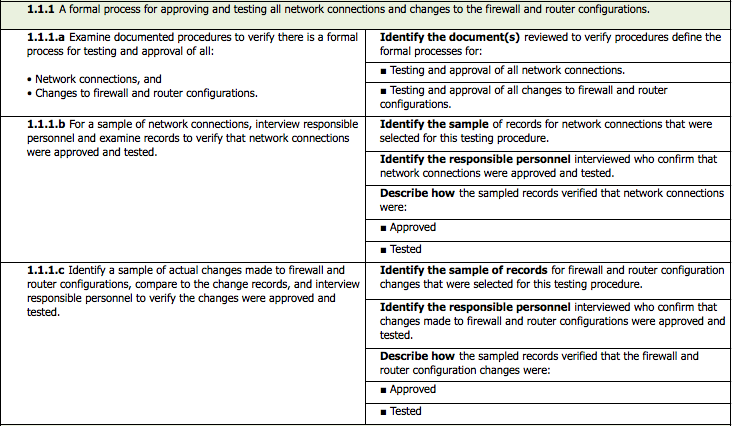
This is from v1.1:

Radically different, right?
Not really, everything in 1.1.1.a – 1.1.1.c is validation guidance, nothing more. In other words, if the original v1.1 assessors were doing a good job, this is how they would have assessed their clients back in 2006.
But they weren’t doing a good job. Not even close. Even into v1.2 QSAs were still filling out ‘Yes’ for in-place and ‘No’ for not-in place.
What we have seen from v1.2 onwards is the gradual increase in detail related to the validation that has to be performed. From v2.0, a separate document was provided to QSAs, the ‘ROC Reporting Instructions for PCI DSS v2.0‘ that broke down what was expected during compliance validation.
This was also implemented poorly by a lot of QSA companies, while others were clearly unaware of its very existence.
Roll on DSS v3.0, the version that caused by far the biggest stir in the PCI community since the DSS’s initial release. There were shouts from the merchants that the SSC had just raised the bar to unacceptable heights. There were even complaints from QSAs that the ‘new’ instructions would increase the workload to the point assessments would be unprofitable. And worst of all, the more unscrupulous QSA companies actually raised their prices! Here are my thoughts on those companies; PCI DSS v3.0 – Do NOT Pay More For Your QSA Services!
The fact is that v3.0 was a consolidation of the DSS Requirements and the Reporting Instructions, and little more (detailed mapping here). If the QSAs and the organisations they were assessing had been performing assessments properly, the effects would have been minimal.
About 82% according to my calculation. Obviously this is at the overarching control level, not the validation detail. v1.1 had exactly zero guidance in that regard.
Other than some wording and requirement numbering changes the controls have remained remarkably consistent.
…and the ‘major’ changes aren’t really that major. Certainly nothing outside of basic common sense:
There are two ways to look at these results:
I think we all know that the first option isn’t true, so that leaves the second. And can you really blame them? Besides, what does it really matter, the DSS will never have the opportunity to improve much beyond minor clarifications. Payment cards just don’t have enough life-span to warrant anything else.
Nothing more to add really, now I need to go get a life.
[If you liked this article, please share! Want more like it, subscribe!]
The SSC released their Information Supplement ‘Effective Daily Log Monitoring‘ in MAY, and I’m only just hearing about it now! Either I’m completely out of the loop (not being a QSA) or the SSC did a very poor job PR-ing it.
I think I understand which it is now that I’ve read it.
Anyway, despite the blatant oxymoron in the document’s title, and my own predisposition toward negative bias where the SSC is concerned, I was still hoping to be pleasantly surprised.
I wasn’t, but nor was I as horrified as I have been while reading output from other SIGs.
It’s actually a really good beginner’s guide to logging, but it’s completely unsupported by the DSS in its current form. And it’s not just me looking for faults, they have not put logging into a proper, or even accurate, context to the DSS requirements as written. With their knowledge of best practice, they basically made the rookie mistake of assuming requirements mean more than they do.
To be clear; If it’s not specifically spelled out in the standard, it is not mandatory. Period / full stop. Even if it’s the right thing to do.
For example: There is no requirement for any automated alerting. Not from firewalls, not from A/V, not from IDS, not from FIM, and not from ‘system components’ like servers and applications. So the statement; “The PCI DSS recognizes the importance of proactive monitoring of security logs in the detection of attacks on information assets and the protection of those assets from compromise.” is inaccurate. The SSC might recognise the importance of pro-active monitoring, the SIG’s participants clearly do, but the DSS only recognises the need for what amounts to forensic evidence. Nothing more.
• Examine the system configuration settings and interview responsible personnel to verify that an automated technical solution that detects and prevents web-based attacks (for example, a web-application firewall) is in place as follows:
– Is configured to either block web-based attacks, or generate an alert that is immediately investigated.” – [Alerts are non-mandatory, and can be manually generated.]
Note: Log harvesting, parsing, and alerting tools may be used to meet this Requirement.” – [Non-mandatory]
So if there’s no requirement for automatically generated alerts, and daily is the maximum defined review timeframe, how can they possibly insist on 24/7 availability related to Incident Response (DSS Req. 12.10.3)? Who is going to choose 2AM for their daily review?
Even the SIG makes the statement; “Without automated alerting mechanisms, it is almost impossible to identify and alert about such events in near real-time.“. In other words, in time to actually do something about it before it gets out of hand.
But I thought this was about effective DAILY log monitoring?
The thing that still confuses me most, is that the DSS is full of mandatory technologies, but a manual and daily review of logs is still OK?! Not one technology in the DSS is required to be utilised properly, and some have significantly less benefit than a Security Incident & Event Management (SIEM) or an equivalent managed service:
So of ALL requirements, how can centralised logging and automated alerts not be mandatory?
This post in already too long, and I’ve barely begun to scratch to surface of why logging and monitoring is so important.
There’s no escaping that the document name; ‘Effective Daily Log Monitoring‘ is misleading, it should be called the ‘We Cannot Tell You to Buy a SIEM, But Good Luck Getting Compliant Without One‘. Basically the SSC has all but admitted that the logging and monitoring requirements are completely inadequate, but can think of no way to change them in the DSS. Not without pissing off a lot of people anyway.
Finally, it IS a good document, worth a read, and kudos to the authors. Unfortunately it’s guidance is meaningless to those without the means to perform anything other than manual daily reviews.
If you’re interested, I have provided some additional thoughts in my own Logging Supplement document. There are 3 sections:
[If you liked this article, please share! Want more like it, subscribe!]