
Over the last 6 months since leaving a 12+ year career at one company, my thoughts come consistently back to one concept; innovation. Making positive change in terms of process and efficiency has always been a passion of mine. Nothing is perfect, and anyone using the phrase; “We’ve always done it that way!” should be fired immediately for gross misconduct.

In much the same way that to someone with a hammer every problem looks like a nail, my natural inclination as a security ‘expert’ is to assign the lion’s share of importance to my area of expertise. While I most likely go too far in this, I think that I have at least some justification for my assertions, if only in the context of this blog.

Innovation is defined as; The act of introducing something new. This is therefore one of the most critical concepts for the human race since it first achieved sentience (couldn’t use the word ‘intelligence’, I think that’s still pending). Whether you believe that was millions of years ago, 6,000-ish year ago, or it was a present from aliens, the speed with which we evolved from hunter-gatherers into what we are now is astonishing (couldn’t use the word ‘civilised’ either, and for the same reason). In just the last 100 years or so we’ve gone from the first flight to the moon, and from computers the size of a room, to mobile devices with more computing power and capacity per unit than existed on the planet just 60 years ago.

All of this was done with one thing as the foundation; information. Yes, that information must be correctly applied to become knowledge – and hopefully in time, wisdom – but everything that has ever been invented, and WILL ever be invented, has information at it’s core. Invention starts with a need, and it does not matter what that need is, someone will feel the urge to fill it. Only a few people create things of no use (we’ll leave Apple and Modern Art out of this), they do it to make money, make a difference, or better the human condition.

The need, in and of itself, is a sort of information; how to take an idea and make something out of it is information; how to build / market / sell / distribute / improve the idea is information; and yes, how to USE the results of the idea is also information.

So why isn’t information better protected?

Why isn’t information seen at the definitive crown jewels in EVERY organisation, especially now that almost every aspect of business is digital, and online? Why don’t CEOs include those in CHARGE of protecting information in the process of business transformation and innovation?

Can’t answer those questions, I’m not smart enough, but seeing as I’m a security expert the why is irrelevant, it’s my job to ‘just get it done’. But that’s the challenge, unless the people ultimately responsible for innovation within a business understand and care about this concept, no-one else is going to care (yes, I’m blaming the CEO …again).

There is an ages old concept in information security; that of Confidentiality, Integrity, and Availability. Some say it’s obsolete and needs refreshing, others try to change the names or add a 4th so that they can be seen to be radical thinkers, but the concept is every bit as valid as it’s ever been:

Confidentiality: If everyone has the information you have, you’re probably not innovating, you’re doing what everyone else is doing. Maybe you’re doing it slightly better than everyone else, but you aren’t going to stay in the lead for long.

Integrity: Not much point innovating if you’re doing it for the wrong reasons, in the wrong place, at the wrong time, or badly. If your information is not accurate and relevant it’s just data.

Availability: You can have all the information in the world, but if you can’t get to it WHEN you need to get to it, it as much use as a politician.

The whole point of IT Security is to take care of confidentiality and integrity, IT Operations takes care of the availability, but it’s the combination of IT Operations,  IT Security and the BUSINESS side to put information into context for ongoing innovation.  That’s what the Governance committee is supposed to be doing; take a business need, help gather the necessary information to devise a solution, measure the business risk, and either move forward with the solution, or move on to the next.

Big data, data mining, predictive analytics and even the much mis-understood ratings and reviews fields would not be experiencing exponential growth if information was not seen as crucial to maintaining competitive advantage. That’s probably why it’s almost incomprehensible to me that organisations don’t take information security more seriously.

Almost.
Once in a great while, a phrase comes along that immediately sparks a thousand thoughts in your head.  It does’t matter if the thoughts are even relevant to the context in which you heard the phrase, the thoughts are there.  Clearly my written English will give this poor justice, and as my Sister is always kind enough to point out; I’ve never met a grammatical error I didn’t like.

Unfortunately the phrase ‘strategically intelligent mistakes‘ is not mine, it’s Accenture’s, but was brought to my attention in a pending article by Peter Livingstone, a Publisher at Financier Worldwide. I will be ‘advertising’ this article when it comes out so that my enormous following can enjoy it.  I’m fairly sure my 18 subscribers will make all the difference to its success.

Accenture’s context is; “Some companies have recognized that they can allow innovation teams to make strategically intelligent mistakes within a clearly understood governance framework. This, in turn, enables a culture that not only tolerates risk but also embraces failure as an integral part of the innovation process.

Which is perfect for the purposes of this blog, (and my last one on Why Everyone Should Start a Business) because it’s very much the thought of failure that prevents so many good ideas from becoming reality, or causes thoughts to die on the vine. That, and having no idea where to start, but that’s blodder for another time.

Whether the idea is for a start-up, a new service line, or an improvement on something that already exists, fear of failure / ridicule / loss of respect, or any number of fear-based de-motivators prevent those ideas from being freely expressed. The only truly bad idea in business is one that never see’s the light of day. Sure, it might fail, fail spectacularly even, but no-one has just one idea, so the next one will have the benefit of experience for the creator, and everyone around them.

Thomas Edison, arguably the most famous inventor in recent history, failed over 3,000 times to invent the lightbulb (though he certainly didn’t phrase it that way).  My favourite quote of his; “Many of life’s failures are people who did not realize how close they were to success when they gave up.

You do not have to be an entrepreneur and start your own business to make a significant impact with your ideas, there are plenty of examples of an ordinary individuals’ idea making significant positive impact on an organisation. It is the CEO who ultimately holds the key to how ideas are received, and whether or not his/her people feel as though their ideas are welcomed, regardless of the possible outcome.

A recurring theme in my blogs is; “Let’s be very clear; The CEO sets the tone for the entire company: its vision, its values, its direction, and its priorities.  If the organisation fails to achieve [enter goal here], it’s the CEOs’ fault, and no-one else’s.

In Accenture’s article, there is this wonderful paragraph; “For instance, a large advertising agency awards a quarterly Heroic Failure trophy to recognize clever, unproven ideas that may not work out in practice, but nevertheless demonstrate creative risk taking. And an online payroll provider offers $400 to the winner of its Best New Mistake award, which goes to an employee who made a mistake but learned from it—and, in doing so, helped other employees avoid similar mistakes. The idea behind both awards is to support creativity by encouraging openness about errors and rewarding those who genuinely learn from their failures.

Can you imagine working for an organisation that rewards and encourages you  regardless of your mistakes.  No, neither can I, but it’s a very pleasant thought isn’t it?

========================

Update 14-Oct-13 15:09: My thanks to Jon Hawes for pointing me at this article; http://blogs.hbr.org/2013/09/how-i-got-my-team-to-fail-more/


I’ve been out on my own for 5 whole months, and I think that gives me the right to tell everyone to start their own business? Well, yes, actually I do, but probably not for the reason you think. I’m also not suggesting it be your sole source of income, though that does lend a certain urgency to it.

To massively oversimplify it; there’s no way you can lose.

Not everyone will be a Steve Jobs (well, eventually …death and taxes and all that), or a Richard Branson, but in the end there are only two outcomes:

  1. Your business is successful enough that you can continue to pursue that course and support your family, or;
  2. Your business fails and you go back to a regular job.

Wait – I assume you’re saying – the second option sounds like the very definition of loss! However, I have had a lot of time over the last few months to consider what would happen if my own business failed and I had to start looking for a day job. Clearly I would be unhappy, and I don’t know of any entrepreneur who doesn’t hope that their start-up becomes the next Google, but seeing as my aspirations are more mundane, I can actually see the many benefits:

First – You sacked-up and did it – For years I have thought I wanted to be out on my own, but didn’t have the nads to make it happen. I am out on my own now because a) I was made ‘redundant’, b) the 9 – 5 options at my level were very sparse, c) I had enough saved that I could give it a go, and, most importantly, d) a wife who does nothing but support my every move. Even the bad ones. You start your own business and your confidence levels shoot through the roof;

Second – You get to find out if being an entrepreneur is actually right for you – It’s VERY easy – for example – to criticise your bosses all the way up to the board of directors about what you see clearly as mistakes they’re making. Now it’s your problem, your mistakes, and potentially YOU who is now the one screwing up your employees’ lives. That’s OK though – not screwing up peoples’ lives of course – because if you do end up going back to a 9 – 5, you’ll have a better understanding of the pressures, and may be able to communicate your solutions in a language they’ll understand;

Third – It’s easy – Of course, I know that NOW, but before I knew how it was done it looks very intimidating. You have to have an idea in the first place, hopefully an existing pipeline, then you fill out forms for Companies House, HMRC, bank accounts, web designs, marketing and the whole gamut. But, and here’s the kicker, there are literally hundreds of people you can ask, and who love to help. My own journey has been ugly, but fascinating, and now that I know what to do, any idea can become a new business, whether I’m running it, or helping someone else;

Fourth – You become far more aware of other business ideas – Whether or not your current venture succeeds, by going through the process you adopt the entrepreneurial mind-set whether you mean to or not. Ever notice how, when you’re considering buying a certain type of car, that you suddenly see them everywhere? Business ideas are the same when you’ve had one of your own (business, not car);

Fifth – You’ll be more content. If your business succeeds, you’ll never be happier, but if it fails, you’ll at least know that when you’re back in your 9 – 5 that starting your own business is not for you, and be more content where you are. Maybe you’ll work for a few years to save the capital for your next business, or maybe you’ll succeed beyond all previous expectations in your 9 -5, either way, you’ll have what too few people out there attain in the Information Age; Self awareness.

Try being content or successful at anything without it.

[If you liked this article, please share! Want more like it, subscribe!]

Even now it’s fairly easy for most technology support people to perform their function. They have either extremely deep knowledge in one sector (PC, Mac, iOS, etc.), or are something of a jack-of-all-trades/techs. Much like a handyman is great for most day-to-day repairs, but should never be used to replace your boiler, your electrical system, or your windows.

But what happens when everything is online? Well, almost everything.

When I raise the subject of Internet of Things, I usually get one of three reactions;

  1. The what of who?
  2. That’s awesome, can’t wait!
  3. No thank you.

The first answer is invariably from people who are not technology oriented (majority), the second one from people who ARE technology oriented and usually young, and the third answer from people who are either terrified of technology itself, or who realise that privacy would be a thing of the past.

It’s hard to argue with the latter when you’ve voluntarily put your entire life’s infrastructure online. Like I will.

But who’s going to support all of this? Governments will do their best to regulate this, and they’ll fail; technology providers will attempt to make it simple and safe for the average user, and they will fail; and your PC repair dude will have little idea where to start, but probably charge you for trying.

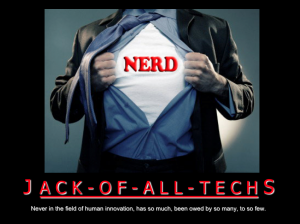
Luckily the technology behind the Internet of Things is already known to most techies, but they can no longer stay as deep into one technology as they may have done in the past, and probably prefer.  Customers will begin demanding jacks-of-all-techs over specific and individual knowledge-sets, and expect them to be able to fix their smartphone, re-program their dogs’ locator chip, and propose a tasty dinner based on the computer generated contents of their fridge.

The new generation of technology support professionals will need to keep up with innovation as never before, or lose out to those that do; your local PC repair shop will lose to home service; and  we, the consumer, will expect this to be seamless, painless, and cheap.

I even foresee both regulation and certification around providing these services. It’s one thing to support a customer who can’t flush his toilet using his iPhone, it’s quite another supporting a customer who is having issues with her pacemaker, or insulin dispenser.

In the race to profit from this technology explosion, standardisation, interoperability, and ease of maintenance will be ignored, meaning that every new technology you deploy will be stand-alone.  Maintenance complexity does not go up linearly with the number of individual technologies, it goes up exponentially.  Support contracts will be how most of these businesses make their money.

However, to the rescue comes the jack-of-all-techs who will not only help you fix what’s broken, but will be able to help you choose what technology you can go for next given their knowledge of what you have now, and what goal(s) you are trying to active.  Every good support person, consultant, or friend, gives you what you need, and not necessarily what you ask for. Even if they use sentences which end in prepositions.

The only thing holding back total technology adoption are people born before 1990. Most people born after that take the Internet, smartphones, and loss of privacy for granted. Every year that goes by our numbers fall, so the checks and balances between the Internet of Things and an individual’s rights for independence from technology are weakened.

Once again, here comes the jack-of-all-techs! The right tech support professional inherently understands that customer service is the only thing that matters, and you can never provide world class customer service if you don’t have your client’s best interests at heart.

Let the learning begin.

Screen Shot 2013-10-03 at 15.02.42

Who doubts that the future of 3-D printing is that you will soon be able to print with almost any substance that can be turned into a spray?  Or better yet, the drive for new compounds and materials will harbour an explosion in stronger-than-metal fibres that will negate the need for high temperature processing?

Obviously this is many years off, but you can already produce some of the crappy little plastic nick-knacks that tourists pay squillions for every year in a 3-D printer you can buy for less than £1,000 and put on your office desk. The price of these printers goes down as the quality goes up (very similar to Moore’s Law on transistors), so it’s fair to say that, like computers, they will become just as mainstream and widespread as any other home computing device.

So why this blog?  I was just sitting here, on a gorgeous Autumn day, in the house in front of my computer (like you do), when I  took a look at everything within my reach to see where it was made.  I’m sure you can guess; anything small plastic and disposable was made in China.  My next though was; what happens to all of those people whose livelihood revolves around making cheap, plastic, disposable, and in no way useful crap, when I can print equally useless crap at home?

Then I thought of a scenario; I see a guy in a far away airport rushing for a plane to get home to his family.  It suddenly occurs to him that he has not bought anything for his for his 2 little children – that’s why it’s a ‘him’ in my story BTW, women are far less stupid – and he has no time to buy something. So, he takes out his smartphone and takes a picture of a generic toy for the country he’s in, processes it through a scanning app, and sends the results to his printer sitting at home in his office.

By the time he gets home, there’s two, identical but for the colour, cheap, plastic, disposable, and in no way useful, pieces of crap sitting on his desk. Great for Daddy, bad for shopkeeper in far away airport, and VERY bad for family scraping by on the income the receive from making the cheap …you get the point.

I have no solution for this, in case you’re wondering, I LOVE the thought of what we’ll be able to do 5 – 10 years from now, nor do I have it in me to do anything more than write a stream-of-consciousness blog on something I read while browsing Wired articles.

I understand that technology, innovation, and the sheer inventiveness of the human race means that things change, and they change quicker every year, and that if you’re not ahead of the wave you will get left behind and potentially suffer.  But I can’t help wonder if this is not a perfect time for concepts such as corporate social responsibility to make their way off the marketing fluff, and into a demonstrable service provided by the leaders in the future trends.

Maybe I just ate a bad bagel…