
My penchant for dramatic titles aside, perhaps a more accurate – and less controversial – title would be; “Why The Card Brands SHOULD Secretly Hate Chip & PIN“, and the reason is simple; it’s in the way of their business.

The only reason chip and PIN (or EMV) is championed publicly by the brands is that it works, and has significantly reduced card present fraud (or face-to-face payments) in those areas that have mandated it, which is basically almost all the world’s industrialised nations except the US. If you want to know why I think the US will never adopt EMV, my thoughts are here; Why the US Will Not Adopt EMV (Chip & PIN)

The most basic and fundamental misunderstanding about EMV is that it’s a payment technology, it’s not, it’s an authentication technology.  And a very inefficient one at that.  The reason it reduces fraud is that anyone can swipe a credit card to buy something, but not everyone has the PIN number associated with that card to complete the transaction.

So the concept is sound, but the implementation is fatally flawed:

  1. It’s not a real-time authorisation, it’s performed offline by the PIN Entry Device (PED) – a.k.a. payment terminal – itself, therefore the PED must have a significant capability that is no longer required given recent innovations in authentication technologies
  2. The PEDs that are EMV capable are incredibly expensive as a result of 1. above (between £400 – $2,000 each), and are therefore out of the reach of the largest retail segment globally; the micro-merchant (e.g. corner store, street market vendor and the like)
  3. It has already been shown as vulnerable to attack. Yes, it was a VERY specific circumstance in which it was broken, and it’s still very difficult to do so, but the only reason it’s not further exploited is because thieves are lazy and there are still so many easier targets out there
  4. The PIN authorisation is only for card payments, it is not extensible to any other scenario where a similar mechanism would be desirable (logging into your bank online, Doctors access medical records etc.)
  5. You still have to carry a piece of plastic around with you, and credit cards are a dying non-cash payment technology

If you accept the above as true, then it’s relatively trivial to determine why the card brands must hate EMV:

  1. It will be very difficult to expand credit cards to regions that are either resisting EMV due to replacement costs (i.e. the US), or initial implementation costs (non-industrialised countries). They simply cannot introduce any card-dependent technology other than one that provides authentication capability
  2. Try telling a merchant in sub-Saharan Africa bringing home less than $1,000 a year that they need to spend a year’s salary to do business with European tourists and you’re not going to get much adoption. A non-EMV PED can be had for less than $100, which is far more palatable. I’m sure some enterprising service provider would be happy to rent them out too
  3. Why roll-out a technology that will eventually be relatively easy to break? Security is not about being totally secure, it’s about being secure enough. Build a secure device and a bad guy will work out how to break it, and this will never change. EMV capable devices are, but their very nature, incapable of adapting to a newer, more secure technology
  4. Authentication needs to be ubiquitous, people simply don’t want lots of different passwords to remember. Authentication as a Service (AaaS) will expand to include payments, and the best way of delivering this service is over a mobile device, not a credit card
  5. In order to continue their reign for a few more years, the card brands must rapidly expand their influence in regions that simply cannot support EMV

In the end you have to realise what the card brands are; they are a mechanism to get access to your money without the use of cash. This was great while they were the only game in town, but they are not anymore, and unless they can justify their interchange fees by  providing secure payments to EVERYONE’S convenience they will be the next victim of disruptive innovation.

EMV has run its course, and I would be VERY surprised if the card brands continue to support it given that fact that it actually hastens their demise, not prolongs it.
Once in a great while, a phrase comes along that immediately sparks a thousand thoughts in your head.  It does’t matter if the thoughts are even relevant to the context in which you heard the phrase, the thoughts are there.  Clearly my written English will give this poor justice, and as my Sister is always kind enough to point out; I’ve never met a grammatical error I didn’t like.

Unfortunately the phrase ‘strategically intelligent mistakes‘ is not mine, it’s Accenture’s, but was brought to my attention in a pending article by Peter Livingstone, a Publisher at Financier Worldwide. I will be ‘advertising’ this article when it comes out so that my enormous following can enjoy it.  I’m fairly sure my 18 subscribers will make all the difference to its success.

Accenture’s context is; “Some companies have recognized that they can allow innovation teams to make strategically intelligent mistakes within a clearly understood governance framework. This, in turn, enables a culture that not only tolerates risk but also embraces failure as an integral part of the innovation process.

Which is perfect for the purposes of this blog, (and my last one on Why Everyone Should Start a Business) because it’s very much the thought of failure that prevents so many good ideas from becoming reality, or causes thoughts to die on the vine. That, and having no idea where to start, but that’s blodder for another time.

Whether the idea is for a start-up, a new service line, or an improvement on something that already exists, fear of failure / ridicule / loss of respect, or any number of fear-based de-motivators prevent those ideas from being freely expressed. The only truly bad idea in business is one that never see’s the light of day. Sure, it might fail, fail spectacularly even, but no-one has just one idea, so the next one will have the benefit of experience for the creator, and everyone around them.

Thomas Edison, arguably the most famous inventor in recent history, failed over 3,000 times to invent the lightbulb (though he certainly didn’t phrase it that way).  My favourite quote of his; “Many of life’s failures are people who did not realize how close they were to success when they gave up.

You do not have to be an entrepreneur and start your own business to make a significant impact with your ideas, there are plenty of examples of an ordinary individuals’ idea making significant positive impact on an organisation. It is the CEO who ultimately holds the key to how ideas are received, and whether or not his/her people feel as though their ideas are welcomed, regardless of the possible outcome.

A recurring theme in my blogs is; “Let’s be very clear; The CEO sets the tone for the entire company: its vision, its values, its direction, and its priorities.  If the organisation fails to achieve [enter goal here], it’s the CEOs’ fault, and no-one else’s.

In Accenture’s article, there is this wonderful paragraph; “For instance, a large advertising agency awards a quarterly Heroic Failure trophy to recognize clever, unproven ideas that may not work out in practice, but nevertheless demonstrate creative risk taking. And an online payroll provider offers $400 to the winner of its Best New Mistake award, which goes to an employee who made a mistake but learned from it—and, in doing so, helped other employees avoid similar mistakes. The idea behind both awards is to support creativity by encouraging openness about errors and rewarding those who genuinely learn from their failures.

Can you imagine working for an organisation that rewards and encourages you  regardless of your mistakes.  No, neither can I, but it’s a very pleasant thought isn’t it?

========================

Update 14-Oct-13 15:09: My thanks to Jon Hawes for pointing me at this article; http://blogs.hbr.org/2013/09/how-i-got-my-team-to-fail-more/


A friend of mine sent me this article today, with the rather humorous note “Just don’t name them Skynet!”; Cyborg Cockroach Sparks Ethics Debate. Like every other issue in the world, there are those for it, and those against it. I’m only writing about it here because innovation and science fascinate me.

Their example for experimentation; “…pleased that the project will teach students about the neuroscience behind brain stimulation treatments that are being used to treat two of his friends with Parkinson’s disease.”

Their examples against; “They encourage amateurs to operate invasively on living organisms” and “encourage thinking of complex living organisms as mere machines or tools.

And my favourite; “I’ll just be happy that I found a cleverly marketed consumer item that I am very happy not to own.”

The debate is of course over ethics. The question is; is it OK to experiment on cockroaches in order to further the cause of neuroscience? The in-favour camp say the benefits are numerous; from treatment of Parkinson’s disease, to non-surgical treatment of epilepsy, to giving back mobility to those who have lost the use of limbs or lost them altogether. The not-in-favour camp say that it’s simply not right morally/ethically/humanely etc., or that you’re teaching kids to be psychopaths.

One side need only point to the numerous examples of life saving medical breakthroughs that involved the use of animal testing to make their argument, the other side need only point to WWII concentration camps to make theirs.

Forget for a moment that we spend billions globally on killing ‘roaches, and that almost every human feels an involuntary shudder of disgust when we see one. Forget also that two extremes of alternative to experimenting on ‘lower’ life forms are 1) experimenting on humans instead, or 2) letting our disorders go untreated. And finally, forget that a large percentage of our medical advances are the result of killing each other in larger numbers; i.e. war. OK, so the last one doesn’t really fit, but is does demonstrate that no issue is simple.

Instead, focus in this; in the end, the only thing that matters to you is your own opinion, and you are either for it, against it – and rather surprisingly given the subject – completely indifferent.  I can see the benefits, and could not care less about ‘roaches, but my opinion would most likely be different if this was a higher life-form, especially dogs.  But wherever you stand on this, both the benefits and the negative ethical connotations are undeniable. It’s the balance that matters, and in most industrial nations, that’s driven by the majority.

The argument I cannot accept is the one where it’s teaching kids to be psychopaths. Yeah, like THAT’S the cause. That’s up there with video games and movies causing violence. It’s not the videos/movies that are the cause, it’s the perspective in which the individual child puts what they see. That is driven mostly by the parent, and how that child is supported during emotional issues. I’d love to see a study on how many well brought up children resort to violence as opposed to those neglected by emotionally distant parents (asuming both sides are given the same stimuli).

That said, I did have an immediate thought for another benefit of this science; We have all come across a very badly behaved dog or child that we would LOVE to see under better control, right? So my idea is to strap electrodes to the owners’, or parents’ heads respectively, and stimulate their feeling of nausea every time their pet/child misbehaves. Perhaps that would get them off their lazy, inconsiderate arses to do something about it.

Of course this issue goes a lot deeper than this blog, but seeing as I’m in the indifferent camp (given my current knowledge of the facts), I’ll leave the debate up to others. I also make no apology for choosing to remain ignorant of what scientists do behind closed doors, I have chosen my battles for now.

Like privacy, this issue will take people on both sides of the fence to make sure we get the innovation we crave, at a price we can ethically afford. I wish them luck.

I’ve been out on my own for 5 whole months, and I think that gives me the right to tell everyone to start their own business? Well, yes, actually I do, but probably not for the reason you think. I’m also not suggesting it be your sole source of income, though that does lend a certain urgency to it.

To massively oversimplify it; there’s no way you can lose.

Not everyone will be a Steve Jobs (well, eventually …death and taxes and all that), or a Richard Branson, but in the end there are only two outcomes:

  1. Your business is successful enough that you can continue to pursue that course and support your family, or;
  2. Your business fails and you go back to a regular job.

Wait – I assume you’re saying – the second option sounds like the very definition of loss! However, I have had a lot of time over the last few months to consider what would happen if my own business failed and I had to start looking for a day job. Clearly I would be unhappy, and I don’t know of any entrepreneur who doesn’t hope that their start-up becomes the next Google, but seeing as my aspirations are more mundane, I can actually see the many benefits:

First – You sacked-up and did it – For years I have thought I wanted to be out on my own, but didn’t have the nads to make it happen. I am out on my own now because a) I was made ‘redundant’, b) the 9 – 5 options at my level were very sparse, c) I had enough saved that I could give it a go, and, most importantly, d) a wife who does nothing but support my every move. Even the bad ones. You start your own business and your confidence levels shoot through the roof;

Second – You get to find out if being an entrepreneur is actually right for you – It’s VERY easy – for example – to criticise your bosses all the way up to the board of directors about what you see clearly as mistakes they’re making. Now it’s your problem, your mistakes, and potentially YOU who is now the one screwing up your employees’ lives. That’s OK though – not screwing up peoples’ lives of course – because if you do end up going back to a 9 – 5, you’ll have a better understanding of the pressures, and may be able to communicate your solutions in a language they’ll understand;

Third – It’s easy – Of course, I know that NOW, but before I knew how it was done it looks very intimidating. You have to have an idea in the first place, hopefully an existing pipeline, then you fill out forms for Companies House, HMRC, bank accounts, web designs, marketing and the whole gamut. But, and here’s the kicker, there are literally hundreds of people you can ask, and who love to help. My own journey has been ugly, but fascinating, and now that I know what to do, any idea can become a new business, whether I’m running it, or helping someone else;

Fourth – You become far more aware of other business ideas – Whether or not your current venture succeeds, by going through the process you adopt the entrepreneurial mind-set whether you mean to or not. Ever notice how, when you’re considering buying a certain type of car, that you suddenly see them everywhere? Business ideas are the same when you’ve had one of your own (business, not car);

Fifth – You’ll be more content. If your business succeeds, you’ll never be happier, but if it fails, you’ll at least know that when you’re back in your 9 – 5 that starting your own business is not for you, and be more content where you are. Maybe you’ll work for a few years to save the capital for your next business, or maybe you’ll succeed beyond all previous expectations in your 9 -5, either way, you’ll have what too few people out there attain in the Information Age; Self awareness.

Try being content or successful at anything without it.

[If you liked this article, please share! Want more like it, subscribe!]

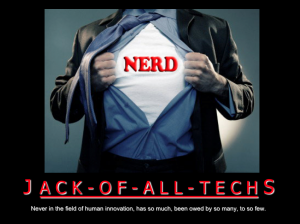
Even now it’s fairly easy for most technology support people to perform their function. They have either extremely deep knowledge in one sector (PC, Mac, iOS, etc.), or are something of a jack-of-all-trades/techs. Much like a handyman is great for most day-to-day repairs, but should never be used to replace your boiler, your electrical system, or your windows.

But what happens when everything is online? Well, almost everything.

When I raise the subject of Internet of Things, I usually get one of three reactions;

  1. The what of who?
  2. That’s awesome, can’t wait!
  3. No thank you.

The first answer is invariably from people who are not technology oriented (majority), the second one from people who ARE technology oriented and usually young, and the third answer from people who are either terrified of technology itself, or who realise that privacy would be a thing of the past.

It’s hard to argue with the latter when you’ve voluntarily put your entire life’s infrastructure online. Like I will.

But who’s going to support all of this? Governments will do their best to regulate this, and they’ll fail; technology providers will attempt to make it simple and safe for the average user, and they will fail; and your PC repair dude will have little idea where to start, but probably charge you for trying.

Luckily the technology behind the Internet of Things is already known to most techies, but they can no longer stay as deep into one technology as they may have done in the past, and probably prefer.  Customers will begin demanding jacks-of-all-techs over specific and individual knowledge-sets, and expect them to be able to fix their smartphone, re-program their dogs’ locator chip, and propose a tasty dinner based on the computer generated contents of their fridge.

The new generation of technology support professionals will need to keep up with innovation as never before, or lose out to those that do; your local PC repair shop will lose to home service; and  we, the consumer, will expect this to be seamless, painless, and cheap.

I even foresee both regulation and certification around providing these services. It’s one thing to support a customer who can’t flush his toilet using his iPhone, it’s quite another supporting a customer who is having issues with her pacemaker, or insulin dispenser.

In the race to profit from this technology explosion, standardisation, interoperability, and ease of maintenance will be ignored, meaning that every new technology you deploy will be stand-alone.  Maintenance complexity does not go up linearly with the number of individual technologies, it goes up exponentially.  Support contracts will be how most of these businesses make their money.

However, to the rescue comes the jack-of-all-techs who will not only help you fix what’s broken, but will be able to help you choose what technology you can go for next given their knowledge of what you have now, and what goal(s) you are trying to active.  Every good support person, consultant, or friend, gives you what you need, and not necessarily what you ask for. Even if they use sentences which end in prepositions.

The only thing holding back total technology adoption are people born before 1990. Most people born after that take the Internet, smartphones, and loss of privacy for granted. Every year that goes by our numbers fall, so the checks and balances between the Internet of Things and an individual’s rights for independence from technology are weakened.

Once again, here comes the jack-of-all-techs! The right tech support professional inherently understands that customer service is the only thing that matters, and you can never provide world class customer service if you don’t have your client’s best interests at heart.

Let the learning begin.

Screen Shot 2013-10-03 at 15.02.42